Solution-Oriented Management: Avoid Blind Decisions
Understand why decisions made without knowledge of the problem are one of the greatest invisible villains and how solution-oriented management reduces risks by prioritizing understanding before execution.
Sapiens IT Team
Written by engineers who build before they write.
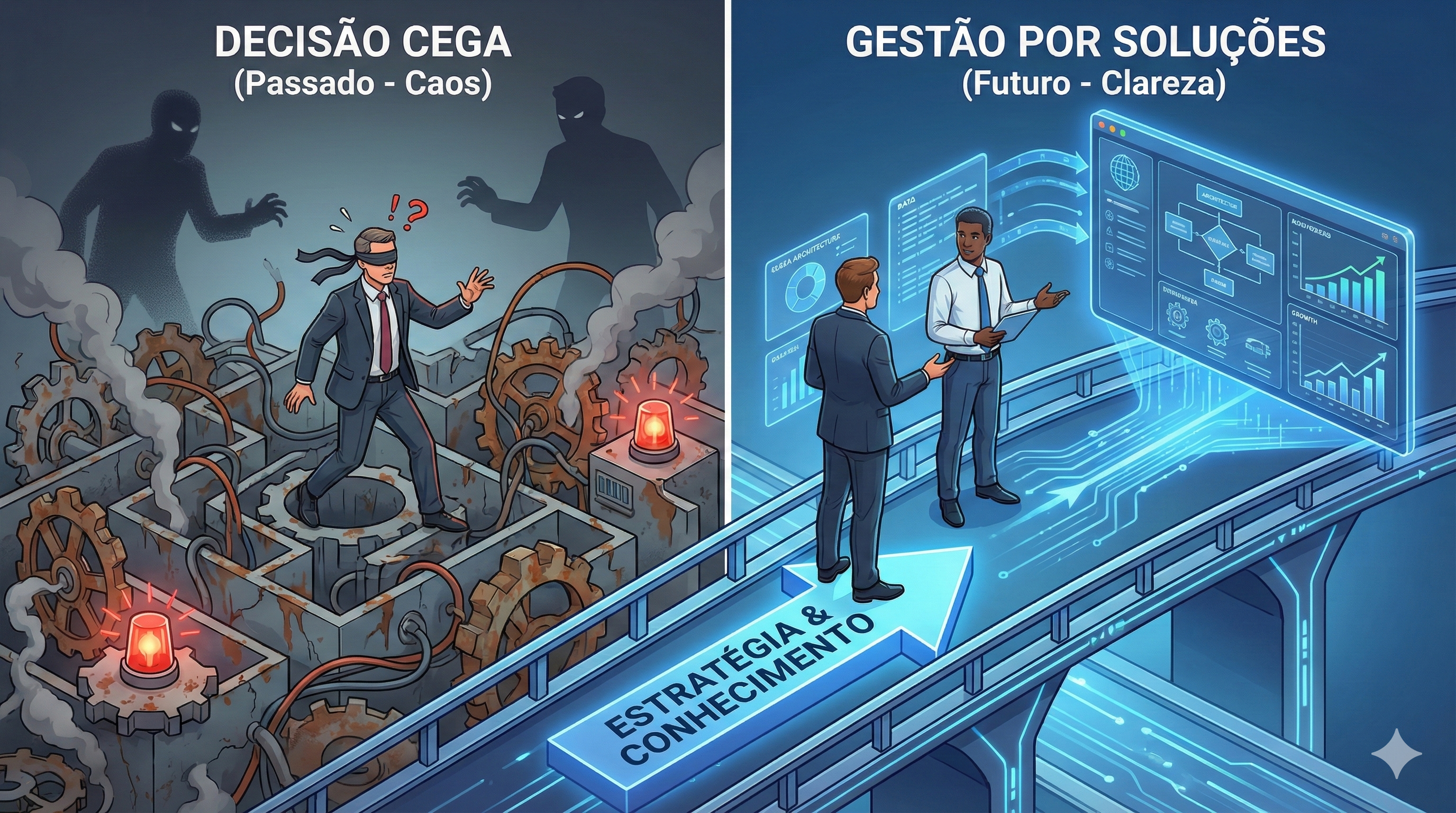
Solution-Oriented Management: Avoid Blind Decisions
“Who is the main villain of your company?” That was the question we asked one of our clients.
The answers revolved around frameworks, programming languages, software architectures, code patterns, and application deployment methods. But all of that were just symptoms that appeared over time.
The central point was not in the tools or methods, but in the why.
Why was that decision made? Why was something defined that way? Why was something else left aside? Why did a new priority emerge?
Understanding the whys prevents decisions from being questioned later.
The problem of decisions without context
Technical improvements, new programming patterns, and new tools emerge all the time, but deciding which to use, when to use, and especially why to use will be decisive for your business success.
Decisions made without knowledge of the problem are one of the greatest invisible villains. When leading a team in high-complexity environments, lacking the necessary basic understanding creates a one-way path that can lead the team and the company to failure.
They arise when choices are guided by:
- Urgency — pressure for immediate results
- Trends — following fads without evaluating real need
- Intuition — trusting only “feeling” without concrete data
And not by understanding the context.
A real example: microservices without need
A simple example occurs when a company decides to adopt microservices just because this architecture is trending.
The decision is made without evaluating:
- Team maturity
- Real scalability need
- Domain complexity
Months later, clear symptoms emerge:
- Dependencies between services that hinder operation
- Increased infrastructure to keep simple processes running
- Cloud costs that grow rapidly
- Loss of visibility over the system as a whole
What was once straightforward becomes expensive, slow, and difficult to control.
The cascading consequences
The company then deals with:
- Constant incidents — flows that break without apparent cause
- Fragmented ecosystem — requires more processes than planned
- Security complexity — each service needs its own policies, separate access controls, and additional protection layers
- Fragmented infrastructure — multiple configuration points, duplicated permissions, and dependencies that need to be kept synchronized
- Operational overload — new pipelines, multiplied monitoring, and teams spending time coordinating changes instead of delivering value
Each simple adjustment now requires:
- Checks between services
- Compatibility between versions
- Distributed tests that drastically reduce delivery speed
The solution: revisiting the cause
The solution begins when the cause is revisited.
The architecture is re-evaluated focusing on the original problem, identifying:
- Which services truly justify independence
- Which can be consolidated
- Where interfaces can be standardized
- How integrations can be simplified
- Where excess fragmentation can be reduced
The review also:
- Unifies security policies
- Organizes identities
- Relieves infrastructure complexity
By recovering clarity and reducing operational overload, the company regains control, reduces costs, and returns to the team the ability to evolve the product without being trapped by complications created by a poorly founded decision.
Solution-oriented management
Solution-oriented management reduces these risks by prioritizing understanding before execution.
It requires that each decision be accompanied by:
- Purpose — what problem are we solving?
- Expected impact — what will change with this decision?
- Validation criteria — how will we know if it worked?
When managers and developers act with clarity about the problem they are solving, the team:
- Chooses technologies with more precision
- Reduces waste
- Creates a sustainable foundation to evolve the product safely
Conclusion
In the end, the true villain is not the tool, the language, or the architecture pattern, but the lack of knowledge that guides decisions.
By reinforcing a culture where each choice is:
- Justified — with clear purpose
- Reviewed — with validation criteria
- Connected to business objectives — aligned with strategy
Companies begin to build solutions with more consistency and predictability. This strengthens the team, reduces rework, and prepares the organization to grow healthily.
If you want to deepen how to make knowledge-based decisions and understand where to find the right vision about the IT world, contact SapiensIT. We have the team and experience necessary to guide you with safety and clarity.
Written by the Sapiens IT team — engineers who build before they write.